The voice of the guitar rang through the upland meadow nestled in the Blue Ridge Mountains of North Carolina, singing blue grass to the crowd. Old and new melodies of the hills, bolstered by the tempo of the band's drum, an old suitcase producing mellow tones, drifted over the fields.
Listening to the mountain music in the evening, hearing soft, southern voices in the day, watching the mist rise silently from many layers of mountain ridges in the morning, laughing as excited children call as they walked across the Swinging Bridge a mile high at Grandfather Mt., and feeling the rhythm of a slower country life, a writer's ear and mind tingle. What enrichment to consider a different accent, cadence, rhythm, inflection, and pace in the language we might consider for our characters' dialogue, voice and setting.
A bonus of summer travel plans is capturing glimpses of these prizes. Some of our members are vacationing in locales somewhat removed from our Middle Atlantic base - Maine where ones hears a more clipped New England accent of Down East, the English of London and the lilt of Ireland, more North Carolina with an eastern coast tone, and the sounds of Seattle and the North West.
What great additions for our use of language - some of which we shall type in subconsciously, and some we will note down on first hearing and use enthusiastically.
In summer, listening to different voices of different places - country music in the meadow or children calling across a mountain top, the strange accent of our own language from a distant shore - enriches our writing life.
Sunday, July 29, 2012
Listening to Different Voices


Wednesday, July 25, 2012
Story Power
To follow up Judy’s previous post, Fiction Matters, some experts argue that stories shape our cultural and moral conscience. In a Wall Street Journal blog, Jonathan Gottschall asserted that fiction can help ‘bring on war (“Uncle Tom’s Cabin”) or rapid social change’ (“Will and Grace” and the liberalization of attitudes towards homosexuality).
Stories help the brain learn and identify emotional truths that can be elusive in our own lives. Repeated fictional images render sights and situations more familiar, less frightening, even routine. Fiction is powerful.
Images of the Aurora shooter, mimicking the famous Batman character the Joker are disturbing. While his incomprehensible actions probably have more to do with seeking glory through publicity than fictional ‘inspiration’ (see this thought provoking segment with noted forensic psychiatrist Dr. Park Dietz)
the link to a fictional story is tragically, orange-ly obvious.
As a society we are increasingly inured to violence in fiction and reality, even weary on occasion. Are writers (fiction, non-fiction, journalist, content provider, etc.) responsible in part for this societal degeneration?
Friday, July 20, 2012
Why Fiction Matters
I went downstairs. My husband had the TV on. And I saw what had happened at another theater halfway across the country. What had happened to other kids who just wanted to enjoy a movie.
Like everyone else in this county, I’ve been thinking about this tragedy all day. How unexpected it was. How incredibly, terribly sad and senseless. But, I still had to work. And work, for me, meant revising my novel.
As I sat at my keyboard, I thought about my characters, their problems and their emotions. While my plot lines don’t involve tragedies like those in Aurora, Colorado, my main goal as a writer is to connect with emotional truths. I think fiction is important like that. As a writer, it’s my job to create characters that allow my readers to feel emotions in deep and meaningful ways.
Writers like Jodi Picoult and Richard Russo have dealt with difficult subjects like school shootings. Patrick Ness left me in a big puddle when I finished A Monster Calls. These are works of fiction, but the emotional truths within the writer’s words lead us as readers to deeper human connections.
That is one reason why this writing job is hard. And why it is so important.
Read more!
Monday, July 16, 2012
Surprise!

Then yesterday when I returned from a walk, I found a surprise!


Wild turkeys! Who'd of thunk it!
And what do these turkeys have to do with writing? Crafting a well-placed surprise jolts readers out of the usual, the ordinary and the expected. And this is a good thing.
Read more!
Tuesday, July 10, 2012
Finding Balance
Finding time for writing has always been a challenge for me. I am guessing it is a challenge for many of us. In recent years, my role as "mommy" has made this challenge even more challenging.
But lately, a new challenge has crept into the picture... It used to be that the majority of time I spent on writing was spent-- writing! Yes, some time was spent on subbing, but writing great manuscripts was the primary goal of my writing time. But lately, I have been devoting an awful lot of time to my writing. Just not in the way I used to.
Time devoted to writing now includes prepping for school visits, doing school visits, doing story times, and, of course, writing to various people suggesting author visits and story times, etc.
Unfortunately, the list above is far from complete. There is so much to do! And everything feels important, and I feel like it is all making a difference for the success of my book.
But I need to find balance. I need to balance writing time and publicity time and mommy time and everything else time.
So how do you all do it? How do you find a balance between publicity / marketing and actual writing? And, of course, the larger question, how do you find balance between writing and the rest of your life? (Making sure that the rest of your life doesn't squeeze out time for writing, as mine did for many years before I made writing a priority.)
Looking forward to hearing how you all make it work1 :o)
Tuesday, July 3, 2012
Should the Market Decide?
This weekend the Wall St. Journal filled us in on the possibilities offered by E books; authors will soon be able to track their readers' choices: the color of men's eyes, the length of sex scenes, the endings of stories. Will economist Milton Friedman's famous maxim, "let the market decide" be the new rallying cry of novelists? Will creativity and artistic decisions yield to the demands of those turning the page? But in Sunday's NYT Book Review we find hope: Sarah Towers' review of Christopher Beha's "What Happened to Sophie Wilder" describes the book as a "meditation of why and for whom we write." Might be worth reading. I get into big trouble when I worry about pleasing those who might read what I write. Clarity and good writing are all important, and rewriting is essential. But what I want to say is mine alone. I can't let the "market" decide for me.
Read more!Sunday, July 1, 2012
Different Writers, Different Responses

Julie's recent post about writers and writing spaces made me think about how much I love to read about famous writers and every aspect of their writing lives: their habits, routines, passions, challenges. And I always appreciate their advice.
So when I came across this post on Flavorwire, detailing writers' responses to children's letters, I immediately clicked through. You should too! It's fun to share Maurice Sendak's delight, J.K. Rowling's empathy, and most of all, Harold Pinter's no nonsense answers to a list of literary questions.
7 HANOVER TERRACE
REGENTS PARK
LONDON N.W.1
AMBASSADOR 9393
4 November 1966.
Dear Master Seaman,
I’m glad to know of the interest of Form 5A in THE CARETAKER. I will answer your questions quite frankly.
i) Davies’ papers are at Sidcup because that’s where they are.
ii) His name is assumed because he assumed it.
iii) The two brothers see little of each other because they rarely meet.
iv) Aston fiddles with his plugs because he likes doing it.
v) When he goes out to walk, he walks.
vi) The monk swears at Davies because he doesn’t like him.
vii) Davies doesn’t like coloured people.
viii) He refuses to believe that he makes noises during the night.
ix) The Buddha is a Buddha.
x) The shed is a shed.
I assure you that these answers to your questions are not intended to be funny.
My best wishes to you all.
Yours sincerely,
(Signed, ‘Harold Pinter’)
Harold Pinter.
What I most love about this response is the brutal simplicity of Pinter's writer's imagination. He created a world and described it "as is". No more, no less. He leaves so much to the reader, and doesn't fear his readers having different interpretations. Or no interpretations at all.
What a contrast to the other writers and their responses to their young fans. But isn't that the beauty of writing? There is room for so many different styles. Lush, sparse and everything in between. And the beauty of reading as writers, is appreciating the work of other writers and writing styles that are totally unlike your own.
As for me, my writing falls more towards the sparse side than the lush side. Yet I can appreciate a good, epic saga that spans decades, even centuries. I love Michael Chabon and Jeffrey Eugenides.
Anybody else out there have favorites that are completely unlike your own writing?
Thursday, June 28, 2012
"And Then What Happened, Mommy?"
"What happens next?" It's all about the story.
Last week I was visiting one of my favorite independent book stores, the Tattered Cover, in Denver, and was browsing in the PB department. A little three year old girl sat, swinging her sandaled feet back and forth, listening to her Mom read to her. The Mom read, "and then ..." and paused. "And then what happened, Mommy?" asked the little girl. "Then what happened?"
There it was - the magic of story. The little girl was mesmerized with the suspense of the story in the PB - What was happening to the characters? What was coming next?
In the MG and YA department next store a brother and sister picked through the novels, sat in the comfortable easy chairs and delved into the stores. Story was alive there between the covers at the Tattered Cover.
How important it is for us children's writers to work at writing excellent stories, that entertain and educate, that build sympathetic characters, apt settings and intriguing plots. And to make the magic happen for children so that they continue to read, whether it's paper bound books in a fascinating booky book store like the Tattered Cover, or electronic ones on their iPad or Kindle.
It's all about the story and what happens next!
Monday, June 25, 2012
Manly Writing Rooms
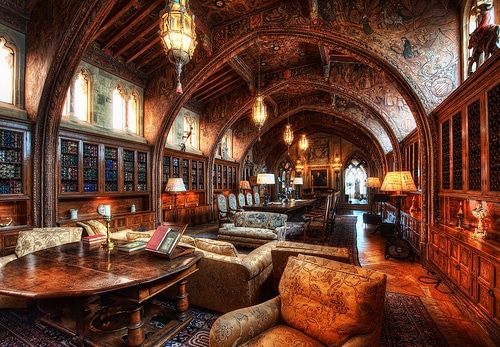
The article includes movie-worthy libraries and studies of authors as famous as Rudyard Kipling, William F. Buckley, Norman Mailer, Sir Arthur Conan Doyle, and a few other notable names. Roald Dahl’s space is such a welcome surprise, I have to share it with you. You can even explore his hut here, through the Roald Dahl museum.
I envy book-walled studies-cum-libraries, finding them soothing and intriguing. Such a collection of classic novels, well-bound references, historical essays and philosophical tomes must confer greatness to a writer in their midst. Right?
I can't help comparing my own space to these (or to the beautiful layouts in the Pottery Barn catalogue for that matter). My shelves are not picturesque. My desk is less so, with works-in-progress competing for desk space with bills, magazines, school forms, etc.
Roald Dahl’s unique space is an inspiration, and a reminder that less can be more. Rows and rows of books – not necessary. Sparse solitude worked wonders for him. I wouldn't call it 'manly', but then again, his hut certainly isn’t feminine, not that it matters.
Mostly, his space was well-defined, and well-used. He was so focused on his work that he often kept the curtain closed. No distractions. Oh that my space was so conducive to productivity. Of all those wonderful writing rooms, I aspire to his.
Which room do you aspire to? What about your office -- how do you see your writing space? Read more!
Wednesday, June 20, 2012
Happy Summer (Reading?!)

Now as a parent I greet the summer with a mix of relief (Yay! We can sleep in!) and worry (Okay, now what?) and the statistics of "summer learning loss" that are tossed around as early as a month before school gets out. I particularly enjoy the commercial for a learning center that shows words literally pouring out of a child's ear as he climbs out of the pool. The parent in me gets completely freaked with this information but there's this other part of me that's like...
Oh. Please. Come. On.
Whatever happened to summer just being summer? Family vacation? Time to goof off? Time to swim, make a sand castle, hunt for treasure, sleep in a tent, capture lightning bugs, run just because it feels good or eat ice pops that turn your tongue purple?
Not that I'm against summer reading - I don't like being the ENFORCER. And while I never had a summer reading list, I usually read during the summer. Mind you, I wasn't reading Newbery winners - more like Forever by Judy Blume or the Flowers in the Attic series by V.C. Andrews. Books that I enjoyed - does it matter if I wasn't analyzing them? Answering essay questions? Thinking about deeper themes and meaning? I read, for the sake of - gasp - reading and I'd really like to raise children who read because they love it as well.
I do think summer reading is important, but so is goofing off. Make anything a requirement and it suddenly becomes a drag. A sure fire way to make any reluctant or rebellious would be reader push away from the table.
So Paper Waiters, what do you think? Is it more important to read from a classic reading list and work on a project than to read for enjoyment? Or can the two co-exist peacefully, especially in the summer? Read more!


