"What happens next?" It's all about the story.
Last week I was visiting one of my favorite independent book stores, the Tattered Cover, in Denver, and was browsing in the PB department. A little three year old girl sat, swinging her sandaled feet back and forth, listening to her Mom read to her. The Mom read, "and then ..." and paused. "And then what happened, Mommy?" asked the little girl. "Then what happened?"
There it was - the magic of story. The little girl was mesmerized with the suspense of the story in the PB - What was happening to the characters? What was coming next?
In the MG and YA department next store a brother and sister picked through the novels, sat in the comfortable easy chairs and delved into the stores. Story was alive there between the covers at the Tattered Cover.
How important it is for us children's writers to work at writing excellent stories, that entertain and educate, that build sympathetic characters, apt settings and intriguing plots. And to make the magic happen for children so that they continue to read, whether it's paper bound books in a fascinating booky book store like the Tattered Cover, or electronic ones on their iPad or Kindle.
It's all about the story and what happens next!
Thursday, June 28, 2012
"And Then What Happened, Mommy?"


Monday, June 25, 2012
Manly Writing Rooms
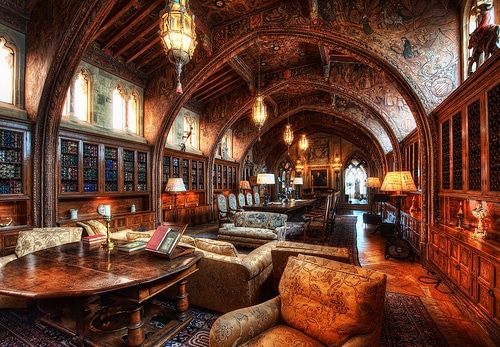
The article includes movie-worthy libraries and studies of authors as famous as Rudyard Kipling, William F. Buckley, Norman Mailer, Sir Arthur Conan Doyle, and a few other notable names. Roald Dahl’s space is such a welcome surprise, I have to share it with you. You can even explore his hut here, through the Roald Dahl museum.
I envy book-walled studies-cum-libraries, finding them soothing and intriguing. Such a collection of classic novels, well-bound references, historical essays and philosophical tomes must confer greatness to a writer in their midst. Right?
I can't help comparing my own space to these (or to the beautiful layouts in the Pottery Barn catalogue for that matter). My shelves are not picturesque. My desk is less so, with works-in-progress competing for desk space with bills, magazines, school forms, etc.
Roald Dahl’s unique space is an inspiration, and a reminder that less can be more. Rows and rows of books – not necessary. Sparse solitude worked wonders for him. I wouldn't call it 'manly', but then again, his hut certainly isn’t feminine, not that it matters.
Mostly, his space was well-defined, and well-used. He was so focused on his work that he often kept the curtain closed. No distractions. Oh that my space was so conducive to productivity. Of all those wonderful writing rooms, I aspire to his.
Which room do you aspire to? What about your office -- how do you see your writing space? Read more!
Wednesday, June 20, 2012
Happy Summer (Reading?!)

Now as a parent I greet the summer with a mix of relief (Yay! We can sleep in!) and worry (Okay, now what?) and the statistics of "summer learning loss" that are tossed around as early as a month before school gets out. I particularly enjoy the commercial for a learning center that shows words literally pouring out of a child's ear as he climbs out of the pool. The parent in me gets completely freaked with this information but there's this other part of me that's like...
Oh. Please. Come. On.
Whatever happened to summer just being summer? Family vacation? Time to goof off? Time to swim, make a sand castle, hunt for treasure, sleep in a tent, capture lightning bugs, run just because it feels good or eat ice pops that turn your tongue purple?
Not that I'm against summer reading - I don't like being the ENFORCER. And while I never had a summer reading list, I usually read during the summer. Mind you, I wasn't reading Newbery winners - more like Forever by Judy Blume or the Flowers in the Attic series by V.C. Andrews. Books that I enjoyed - does it matter if I wasn't analyzing them? Answering essay questions? Thinking about deeper themes and meaning? I read, for the sake of - gasp - reading and I'd really like to raise children who read because they love it as well.
I do think summer reading is important, but so is goofing off. Make anything a requirement and it suddenly becomes a drag. A sure fire way to make any reluctant or rebellious would be reader push away from the table.
So Paper Waiters, what do you think? Is it more important to read from a classic reading list and work on a project than to read for enjoyment? Or can the two co-exist peacefully, especially in the summer? Read more!
Saturday, June 16, 2012
Sentences That Breathe

In "My Life's Sentences" a brilliant article about writing, (New York Times, 3/18/12) Jhumpa Lahiri claims: "They (sentences) remain the test, whether or not to read something. The most compelling narrative, expressed in sentences with which I have no chemical reaction, or an adverse one, leaves me cold." So what sort of sentence keeps the reader hooked?
"Certain sentences breathe and shift about, like live matter in soil. The first sentence of a book is a handshake, perhaps an embrace. Style and personality are irrelevant. They can be formal or casual. They can be tall or short or fat or thin. But they need to contain a charge. A live current, which shocks and illuminates ... Sentences are the bricks as well as the mortar, the motor as well as the fuel. They are the cells, the individual stitches. Their nature is at once solitary and social. Sentences establish tone, and set the pace."
How does Jhumpa Lahiri create the sentences in her fiction? "After an initial phase of sitting patiently, not so patiently, . . . they begin arriving fully formed. . . I hear sentences as I'm staring out the window, or chopping vegetables. They are pieces of a jigsaw puzzle, handed to me in no particular order."
Later, they are "sorted, picked over, organized, changed. Most will be dispensed with. All the revision I do - and this process begins immediately, accompanying the gestation - occurs at the sentence level. It is by fussing with sentences that a character becomes clear to me, that a plot unfolds. . . As a book or story nears completion, I grow acutely, obsessively conscious of each sentence in the text. Each sentence is "confronted, inspected, turned inside out."
Does her writing process seem unusual? Or do you also work this way?
Tuesday, June 12, 2012
The Personality of the Narrator

Westerfeld's heroine Tally Youngblood is bold, frank, original; restlessly counting down the days till her 16th birthday and the total makeover that will turn her into a flawless, bubble-headed “Pretty.” With this first line Westerfeld sets up a tension with the scenario he’s set up for Tally; we know a girl that who sees sunsets as cat vomit won’t find it easy to conform. He sets up a tension between his scenario of seeming perfection and his view of that world. (In this case the narrator is third person, but very close to Tally's point of view most of the time.)
Choosing the narrative voice is one way of choosing what kind of writer you want to be. How do you choose your narrative voice? Do you think about it consciously? Or does it just flow out of you? Read more!
Friday, June 8, 2012
Enjoying Publication!
 Last month I wrote about the mammoth to do list I was attempting to accomplish in the two weeks prior to the publication of my picture book, "Where Do Diggers Sleep at Night?"
At times, accomplishing all the tasks on the list seemed impossible. But now, several weeks after my book is available for purchase, I can give you the update and...
I did it! Nearly every task I listed is done
The book trailer is now complete. (And I think it looks pretty awesome!) You can check it out here:
And the online Truck Stop Book Launch party was a truckload of fun! (I haven't taken it down yet, so if you haven't gotten a chance to visit yet, please do! Truck Stop Book Launch
And school visits have been so much fun! Especially the one to the elementary school I attended as a child. (My fourth grade teacher brought my fourth grade picture to show to her current second graders. Thanks Mrs. Moskowitz!)
And the Touch-a-Truck day that the Junior League of Seattle planned was so much fun! I got to sign copies of DIGGERS (alongside Seattle's awesome Mockingbird Books) for lots of books for lots of enthusiastic truck fans!
So that's the update! I'm so glad that last month's craziness is gone!
Although it's still pretty hectic around here.
(Two more school visits next week!
Yay! This is fun!)
Monday, June 4, 2012
Dark and Stormy Doesn't Do It
"Tt was a dark and stormy night." This opening line in Bulwer Lytton's "The Last Days of Pompeii," is considered a literary joke. For years the sentence has been used as an example of how not to open a novel. Today one must start in the middle of the action. Hook the reader, expecially the younger reader. No more scene painting. Description is to be used like salt or vinegar. Sparingly. I'm not so sure I agree with this. Wouldn't a good opening paragraph with time, place, weather, scenery, be beneficial to the reader? Guess not. Like a TV viewer surfing channels for an eyecatching flick, the young reader wants the first line to pull him in. "Lights, camera, action" works best. So I've been examining my manuscript for the eyecatcher. Apparently it is not a teenage farm girl in front of a hot stove. Guess I have to trot out the dead body a little earlier.
Read more!Saturday, June 2, 2012
Camping In

I'm camping in this June. Okay, maybe I'll spend some time on my deck with my laptop, but I'm camping in with Camp Nanowrimo. Yes, for those of you who always yearned to write a novel in a month, but couldn't imagine speed writing in November, you can now attend Camp Nanowrimo in June or August!
Camp Nanowrimo works perfectly for me. I had already decided to buckle down and finish my revision in June. Now I have friends and emails cheering me on to reach that finish line.
So excuse me if this post is short -- I have a lot of work to do. And who knows, if all goes well, maybe I'll go to camp in August, too! Read more!
Monday, May 28, 2012
An Asset
I have always found that being a writer is an asset in many ways but in unusual circumstances it becomes a great asset. Sitting for long periods of time in a hospital room or a rehab center when a loved one has a prolonged and serious illness, as my husband has suffered recently, can be draining and wearying since you need to be there but you can't help with what is needed medically. But, as a writer, I can be present for him and write too. With a pad and pen, laptop and Ipad I can work almost anywhere. I have reviewed my critique group members' manuscripts for the meeting last week (Writers - they are in the mail!) and work on my own manuscipts. I can revise, revise, revise, updating changes on the laptop or home computer at night. At the same time I get to travel to the locales of each story, to a supernatural new world of one colleague and a local high school of another colleague's current WIP where the MC struggles with his unique problems. I can travel to the Himalaya Mountains, scene of a new PB manuscript of mine or back in time to medieval England which is the setting for a historical fiction PB that I am working on. As Julie mentioned on her last post here, one goal of a writer is to keep the story going and moving forward, even if it is a little at a time. So I keep up with my characters' journeys and the changes in the plots and protagonists of the blossoming books of my writing colleagues.
Read more!Friday, May 25, 2012
Words Are Not Enough
This year I have made progress on several
projects, although I haven’t written as much as I intended. As
the summer looms, and the inevitability of children rushing through my house
all day approaches, I realize I will get even less done each day than I do now. How can I write more, and write it faster?
Many authors measure their progress in words per day. This doesn’t seem to work for me. I need to be a more ‘effective writer.’


