As I sit here on this rainy morning pondering what words of wisdom I'm going to lay on you, my lovely Paper Wait readers, I realize no matter what I say, I will most likely fall spectacularly short. Confession: at the moment I'm feeling a bit empty, maybe even melancholy.
This past weekend, my son went off to college for the first time. And oh...so many feels.
Showing posts with label Revision. Show all posts
Showing posts with label Revision. Show all posts
Wednesday, August 21, 2013
Fly, Be Free


Tuesday, August 13, 2013
Revising and Revising and Revising!
Recently I had a lot of fun revising a manuscript. Well... it wasn't fun all the way through.
Basically here's how my revision process went...
Wednesday, July 24, 2013
A Writer's Workout
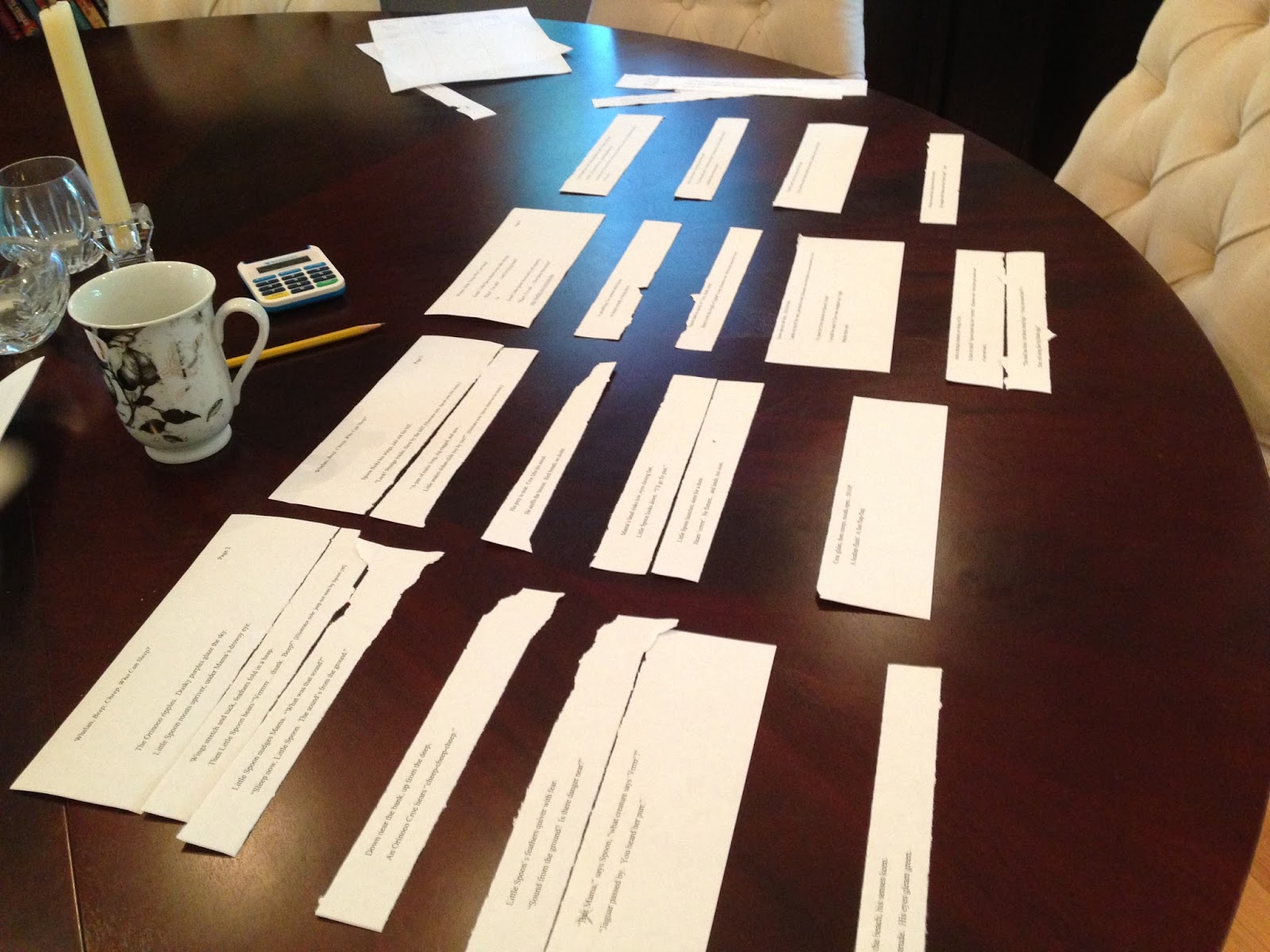
At the suggestion of a critique partner, I cut my latest
manuscript into pieces. I tell ya,
critiques can be rough!
Seriously, they can.
But this was a new angle on revision.
I’m putting my ms back together like one of those magnetic poetry puzzles.
I mix and match the couplets that make
up my PB, see what’s essential and what’s not.
In one exercise, I looked at only scenes with the main character. A verse I thought was critical is actually
redundant. In another, I looked at only
the bad guy. Turns out he might be just
as threatening without a verse or two.
Next, I’m going to rearrange the scenes with plot flow in mind.
Something about the physicality– the touch and the visual of
the paper pieces moving around, pushes my creativity button. It’s also faster than doing it online.
More physicality to come when I create a PB dummy for
dummies by taping the paper verse over the text in an existing picture
book. You can see page turns and imagine
the rising and falling action. (Another
helpful suggestion from a critique partner!)
All this physical hand waving and paper movement – maybe I'll lose some weight.
It’s impressive what new insights can be gained by viewing a
puzzle from a different angle, like unexpectedly viewing a mirror or photograph
of myself from the back (ooooh, that writer’s workout isn’t reaching much beyond
my elbows...).
Another great suggestion for a paper and glue workout comes
from an interview with Jo Knowles (Lessons from a Dead Girl) on Inkygirl. For her novels, she creates a storyboard.
Each chapter is represented by a simple picture (think stick figures a
la Blues Clues), a quick plot summary below the picture, and the strongest
emotion labeled at the top. The story arc is immediately apparent -- a one
glance view of the ms. It’s a great tool
that should be just as (if not more) useful for PBs as well.
So writers, go get physical!
Let me know if you have any other suggestions for a writer’s workout,
especially any that work off the weight that shows in those rear-view pictures.
Read more!
Monday, July 15, 2013
One Haiku: Help Wanted

Each year when we go to Maine, I take along a haiku for kids about sunset at the ocean. I've been fiddling with it for years - this metaphor about the setting sun as a basketball. Should the sinking sun be described as a slam dunk or a swish shot?
This year, you can help me decide.
Read more!
Thursday, June 13, 2013
POV Problem

Is 1st person point of view a good choice for a picture book? It was for Alexander and the Horrible, Terrible, No Good, Very Bad Day. Yes, it's written in 1st person POV, but he is named. Who can forget Alexander?
Can you think of a picture book in 1st person where the narrator isn't named? As of this minute, I can't.
This week something dawned on me. It took a while!
Read more!
Friday, May 24, 2013
Sound Resources

In the process of revising a manuscript AGAIN, I’ve been
digging in to some familiar and newly-found websites to ignite my creative flame. (And, darn it, yes, I am able to make the manuscript better, even though I swore the *#@$ thing was finished.) I
thought others might find some of these resources useful.
One of my revision goals has been to use more powerful and
descriptive words, especially since this story uses a lot of onomatopoeia—sound
words. If words like sizzle,
snarl, twang, whallop, belch, boosh, flump get you thinking and
describing more vividly, then check some of these sites out.
Read more!
Wednesday, February 6, 2013
The Crazy of Writing a Sequel
The Paper Wait is thrilled to welcome Anna Staniszewski for this awesome guest post! Anna is busy preparing for the launch of her upcoming book, My Epic Fairy Tale Fail.

Now that my second book is almost out in the world, I can safely say that, in my experience, writing a sequel is a marathon of crazy. You find yourself having extreme, often-opposite feelings simultaneously during pretty much every step of the process. Here are some examples:
Scenario: You find out you’ve sold a sequel to your publisher.
Reaction 1 - Yay, I get to write another book!
Reaction 2 - Oh my, I have to write another book.
Scenario: You send the first draft to your editor.
Reaction 1 - Yay, I’m one step closer to having this book be done!
Reaction 2 - Oh my, I hope my editor doesn’t realize she’s made a huge mistake.
Scenario: You get a fan letter from a reader who can’t wait for the next book in the series.
Reaction 1 - Yay, people are reading my book and LIKING IT!
Reaction 2 - Oh my, what if readers are disappointed by the sequel?
And on and on and on. With each tiny accomplishment comes a dose of self-doubt and pressure—oh, the pressure! Of course, 99% of that pressure comes from you, but that doesn’t make it any less…pressuring.
Do I have any advice for how to deal with this crazy rollercoaster? Sort of. I have to say that digging into the manuscript and watching it grow stronger with every revision helped quell some of my fears. (It also helped that I had people like my husband reassuring me that if my editor hated my book, she would probably let me know.)
I think what really freed me up after the first draft was finished was the realization that I wasn’t having enough fun with the story. I wrote the first book in the series as a break from other projects, not thinking it would ever get published. Writing the second book under contract was a hugely different experience. If I could recapture some of the fun of the first book, maybe I would feel better about the second one. And you know what? Once I unleashed my inner wackiness, it helped make the process of writing the sequel a lot more enjoyable.
Now, I wouldn’t want anyone to think that I haven’t been truly appreciative for the opportunity to take my characters on more adventures. Or that writing the sequel has been a horrible experience. It’s certainly been a lot of work, but it’s been work that I’m quite proud of. And guess what? Now that the sequel is all ready to go, I get to (have to) do it all over again with the third book!

Born in Poland and raised in the United States, Anna Staniszewski grew up loving stories in both Polish and English. She was named the 2006-2007 Writer-in-Residence at the Boston Public Library and a winner of the 2009 PEN New England Susan P. Bloom Discovery Award.
Currently, Anna lives outside of Boston with her husband and their adopted black Labrador, Emma. When she’s not writing, Anna spends her time teaching, reading, and challenging unicorns to games of hopscotch. Her first novel, My Very UnFairy Tale Life, was released by Sourcebooks Jabberwocky in November 2011. The sequel, My Epic Fairy Tale Fail, is coming on March 1, 2013. Visit www.annastan.com for more info.
Read more!
Tuesday, December 11, 2012
A Chain of Changes
Recently I read a very inspiring blog post. It challenged me to rename three characters where I had settled for bland, generic names. The new names I came up with were much more interesting. (At least, I hope they are. :o) )
But, what really surprised me was how involved a revision this seemingly simple change entailed. I mean, it should be a simple matter of cut and paste, right? \
But it was far from that. Nothing simple about it.
The change of names reverberated through my manuscript. (Just as Ann Whitford Paul had suggested they would!) After re-naming my characters, I discovered the birth order of my young protagonists and how that fit into their motivation within the story.
And, once I gave my characters more interesting names, my last stanza no longer worked. I think that subconsciously, that last stanza had always bothered me a bit. But with the new names, somehow I could no longer pretend to myself that my original attempt at an ending worked. It needed revising. And that revising was challenging but fun to do.
Yes, those new character names really did set in motion a chain of changes. Good ones, I hope!
Has a relatively minor revision ever sparked a chain of changes in your writing? How did your chain of changes turn out?
Wednesday, October 10, 2012
Inspired by Rejection!
Recently I received a wonderful rejection from an editor.
Non-writers always look at me strange when I say those two words together. "Wonderful" and "rejection". How can a rejection be wonderful? they wonder.
But writers know. Rejections can be wonderful. And this one was...
It was so wonderful because the editor gave me wonderful suggestions for my manuscript. Suggestions that really made sense to me.
So I got to revising. And revising. And revising!
Have you ever noticed how you can't just make one simple change in a manuscript. Every change sparked other changes.
And in the end it was a pretty different manuscript. But still the same, if that makes any sense.
All the best parts were there. But it felt fresh and new.
A true re-vision. Thanks to a wonderful rejection!
So, what wonderful rejections have you had?
Wednesday, October 3, 2012
Revision Tip - Make Bad Choices

My revision passes usually have specific purposes. When I've finished my first draft, my first revision deals solely with plot. I rearrange here, add or subtract there, build up plot threads and kill off and combine characters. I do additional revisions focusing on character, setting, dialogue, beginnings and endings, etc. But I've recently added another revision pass that has changed the way I look at the entire process. I call it the "make bad choices" pass.
I've written before about my tendency to make my characters too good for their own good. Sure, bad things might happen to them, but my initial impulse is to let them take the high road to get out of any mess.
Now, I still let them have their nobility in my first draft, but when I get to the make bad choices draft, well, I let them make bad choices.
So here is what I do. I go through my manuscript and mark up every time my characters make a choice. It could be as monumental as whether to have sex or as small as what flavor ice cream to order. Then, I make them make the worst possible choice and see what happens. The results could be as devastating as a teen pregnancy or as embarrassing as a white shirt with a chocolate stain in a strategic spot. I may not keep every bad choice, but I always end with a meatier, more tension-filled story.
Anybody else care to share about revision? Read more!
Wednesday, August 1, 2012
Brain Freeze

GAH!
Wait, no, that's honestly not the right feeling. It's more like the above picture of a dried out sea sponge...empty. Maybe I shouldn't be posting this but I know in the past I've made it clear that I have a love/hate relationship with revision. Yes, it's hard but exciting and ultimately I embrace it, since revision is like 80% of the process, isn't it?
The dried out brain feeling is heinous, though. I feel like I've turned every stone, gone down every path, asked "what if?" about a gazillion times. The request for more revisions has me stymied because my characters have suddenly gone AWOL. ( It's summer, they're teenagers, I guess I should give them a break.) I've taken to putting my subconscious to work, posing questions right before I go to sleep so when I wake up I can have a "eureka" moment.
Still waiting on that one.
In the meantime I'm working on small edits. I know it will all work out fine, my characters will sheepishly show up on my doorstep during down dog or while I'm taking a shower, but oh, the angst of waiting for it!!
So, Paper Waiters, have you ever felt this way? What do you do to remedy this feeling? Read more!
Monday, April 16, 2012
Inspiration . . . Frustration, Chapter IV

Chapter summary:
2011 - Chapter I. PB truck story finally gets written. (Aug. 11th post)
Chapter II. PB truck story goes to a conference. PB truck story appeals to an editor and she takes it with her. (Sept. 28th post)
Chapter III - PB truck story is revised twice (based on editorial suggestions) and resubmitted in November. Email from editor saying "looking forward to reading it over the long weekend." (Thanksgiving)
2012 - Chapter III, con't. Email from editor on 1/20, "looking over it now . . . more thorough response soon." (Feb. 16th post)
Last Thursday, tired of waiting for a response, I called the editor and left a message. Two hours later, I received an email
REJECTION . . "most likely not going to work . . . the plot has become too complex . . . the sweetness and charm of the first draft has been obscured. One thing I regret about our earlier revision talks is that I think I may have been too forthcoming with my own ideas. I would be happy to see another draft, but you know what my hesitations are so it's up to you whether you want to put in more work." She wrote a long and thoughtful rejection letter and I agree with some of her comments.
For months I felt disassociated from this story. It belonged to the editor and she controlled its fate. The worst part about a rejection? Now the story's mine again. I'm forced to face the fact that my first draft needed work, but the changes I made last November damaged the tone of the story.
Revision is a tricky! But that won't stop me.
Saturday, March 24, 2012
Giraffe Juggling

Yet it attracts me. I love to read rhymes aloud, from Dr. Seuss to Mother Goose. Rhymes are texts I remember, from Good Night Moon to The Gruffalo. My feet tap and my head bops when I read Barnyard Dance or Jazz Baby. My kids don’t think of Shel Silverstein’s books as poetry, they think of them as fun. Good rhyme is timeless.
And despite the alarm bells, good rhyme is good business.
And there’s the rub: can I write a good rhyme? I can, at least, try. And I can’t help myself – it is fun.
Some of the mechanical details are lost in my high school memory fog: poetic rules for slants, accents, structure and form. Any suggestions on favorite poetic resources would be appreciated.
I read my stanzas aloud and I know that the rhyme must flow as naturally as dialogue, it must not be forced, and each verse must serve the purpose of the story, moving the plot forward. Knowing however is not always the same as doing.
I’m going to try anyway. If anyone has any good tips on giraffe juggling, that would be appreciated.
What resources do you use to help you hone this irresistible craft? Do you have any success stories about juggling giraffes (ok, or writing)? Read more!
Sunday, January 8, 2012
The Power of Waiting
As writers, we spend a lot of time waiting. And it's not our favorite part of being a writer. Not by a long shot.
But sometimes, waiting can be helpful.
Recently, I had one of those times.
Some time ago, I drafted a picture book and sent it to my critique group for feedback.
The group gave me wonderful feedback. (Thanks guys! :o) ) And almost everybody suggested I make a certain change.
After that meeting, I sat down to revise. And I tried to make that change. I really did. But somehow, I just couldn't make it work.
So, I made a minor adjustment that made it a bit better and tried to convince myself that the manuscript was as good as can be.
"Done," I tried to tell myself.
Then came the waiting. I wasn't even aware I was waiting, but time passed. Several months, in fact. Suddenly, I could see my manuscript much more clearly.
Now I could see it. I had to try to make the change my critique group had so wisely suggested. And my mind went to work on solving the problem.
What had seemed impossible several months earlier, suddenly felt doable. I experimented until I came up with a solution that worked.
It may not be perfect. But I do think it is much better. And after a few months of waiting, making the change became possible.
So, what positives (if any) have you found from waiting?
Sunday, December 4, 2011
A Constant Reminder
I took away an important suggestion from the latest critique of my manuscript. I must let my reader get closer to my protagonist; to feel what she is thinking, to know what she wants, and to be continually reminded of it.
A seasonal analogy presents itself in the old song, "The Twelve Days of Christmas." Each day the recipient gets a gift from his true love, along with a "partridge in a pear tree." Imagine the song without this quirky refrain to tie it together. Flat. Boring. A series of things, and not much fun to sing.
As the story moves forward, I've got to see that my heroine's hopes and dreams are like the refrain of that song; barely noticeable, but never absent.
Tuesday, September 20, 2011
Detachment...an ongoing practice

In Yoga, detachment is the practice of withdrawing the senses from stimulation. This works on many levels. At most basic – for instance closing your eyes – it allows you to go deeper within yourself and simply be a witness to your body in the pose. Not to judge, or compare yourself to your neighbor whose bakasana defies the laws of gravity, but to let the pose come naturally into your body all the while accepting, even embracing, your limitations. On a bigger picture level, it’s about relinquishing control. Not giving a person, place or thing so much importance that when your desires aren’t met it causes you suffering.
Ah, about that bigger picture stuff…
In writing, at least for me, detachment means letting go of desired outcomes. Easy? Um, no. I’ve been struggling with revision – and by struggling I mean completely paralyzed with fear about going back into my manuscript and making changes. Maybe it’s that I hypnotized myself into believing that my first draft was actually a finished novel (HA!). Maybe it’s that once I start playing and picking and killing my darlings I’m worried the whole thing will unravel and I’ll be left with…nothing. Whatever it is, I’ve been avoiding my 3 ring binder like it’s going to grow teeth and devour me.
Why?
Because I have absolutely no control over the million dollar question…will my work be picked up by a publisher? And if not, are the hours, days, weeks, months, even years I put into a project worth it?
This is where I’m trying like hell to practice detachment. My writing has brought so many wonderful experiences and people into my life but I’d be lying if I said I wasn’t hoping and ultimately working toward having something more concrete to show for it. There’s no secret handshake, no list of steps that will ultimately lead you to that book (or books) on the shelf with your name on it. There’s hard work and more hard work. And absolutely no guarantees. Why, oh, why do any of us pursue this?
I’m not sure I have a simple answer to that. And that’s okay. So for now, all I can do is take a breath, close my eyes (momentarily at least) and open that 3 ring binder to begin yet another journey along my writing path. Not worrying about the outcome, but focusing on writing the best book I can.
How about you? What keeps you going on your writing journey?
Tuesday, June 7, 2011
Revising... and Revising... and Revising!!!
I've been busy revising a manuscript these past few weeks. It is a manuscript that I have revised many times before. Each time I see it getting sharper, better, funnier (at least, I hope it is). But it still amazes me how many times I can revise a manuscript that now (thank goodness!) weighs in at less than 500 words.
Characters can be cut. Storylines and wording can be simplified. Humor can be added (or at least I can try to). I'm sure there are more things I've worked at, but these are some of the most recent. It's overwhelming and exciting all at the same time.
Hopefully the new manuscript that emerges will be better than what came before. Right now I'm so immersed in the process I can't quite tell how it's going to end up. The excitement of being a picture book writer!
So how does your revision process go? Does it feel crazy too?
Saturday, June 4, 2011
Don't turn out the lights.
I am again working on the first chapter of my manuscript. If the chapter were a lightbulb, I'd say it was 40 watts.
I have not made the problem clear initially, and that's causing succeeding chapters to lose power, as though they were running off a wobbly generator.
I have written other first chapters for this manuscript, but they seem to belong elsewhere in the book. Not in the beginning. The present final chapter comes, as it were, at the end of the grid, and the impact is very weak indeed.
I've just finished "Major Pettigrew's Last Stand" by Helen Simonson, published in 2010. While not a childen's novel, it is a delightful read, worth mentioning on this blog because it is a "first" novel and made it directly on to the Times Bestseller List.
I've gone back and examined its first chapter. Indeed, all plot threads are laid out in these pages. Like a good electrician who knows which wires will serve which parts of a dark house, a good writer must be sure that each thread snakes through the novel with enough "juice" to light up the ending. I'm sure Ms. Simonson rewrote that first chapter more than once.
To complete the metaphor, I've got to start my novel at 100 watts and finish with 100watts. No burned out bulbs in between.
Wednesday, May 4, 2011
To Begin...No, Don't Use That Word...
I am finally undertaking the revision. Exactly one year after I finished the novel. The "rules" of writing and revision have been knocking around in my head all these months: the first chapter must hook your reader. The reader must care about your characters, and don't have too many of them. (Characters, not readers.) Eliminate the use of the verb "to be" as much as possible. Dump those participles. Watch out for too many adjectives. No adverbs, please. Don't use "began." Curb your figurative speech. Identify who's talking. Eliminate anything that does not move the plot along. No telling. Maintain the point of view. Quite possibly, I am really not a writer. However, I'm stuck with this story that I think deserves to be told...maybe.
Well, just what makes a good storyteller? I was struck by a phrase in Sunday's reading from St. John, where the disciples discover the tomb is empty. The other three gospel writers tell of this moment as well, but only the author of this gospel describes "...the napkin, that was about his head, not lying with the linen clothers, but wrapped together in a place by itself." These words are unnecessary to the purpose of the story, but furnish a detail that firmly imprints the scene on the mind of the reader. Good story telling, I think. I'll keep it...in mind, as I begin...again.
Monday, May 2, 2011
Lessons from LOST
Okay. I admit it. I’m one of the few who never saw a single episode of LOST when it ran on network TV. And do I ever regret it.
See, I was looking for a little motivational help to stay on the old exercise bike on a daily basis. I had just finished watching HBO’s ROME – also really, really good – and found that looking forward to watching the show, made me actually ride the stinkin’ bike. So I took a trip to my local library and picked up season one of LOST. And I’m telling you right now, if you see a thinner me by mid-summer, when I’ve finished season six, I will give more credit to LOST than I will to the exercise bike.
Tension? Oh yeah, we got tension. Twists, turns, surprises? Uh-huh! How about foreshadowing – any foreshadowing here? In spades. And my absolute favorite thing – you know that writing advice, when you’re stuck make something bad happen to your character? Just watch one episode and see so many terrible things happen, your head – or one of their heads – might literally spin!
So how can I take this info and apply it to my WIP? I don’t think it will work to have my main character accidentally stand on a beehive, or have a rockslide cover the door to his house, or have some random, terrifying animal run through his neighborhood. But I am spending a lot more time figuring out ways to ratchet up the tension. Because if tension makes me stay on an exercise bike, it surely will make people read my book.
So what other television shows have I missed that keep you wanting more, more, more every week? What else should I watch for plot and tension?
Subscribe to:
Posts (Atom)


