Showing posts with label writers on writing. Show all posts

Friday, January 24, 2014

Endings

Wikimedia Commons: Photo by Roke.
The end of one thing is the beginning of another, even if you're not sure what the next thing is yet.  This blog is coming to a rest, and I seem to be searching for comfort lines.   I hate endings, fictional or real.

Read more!

Tuesday, December 24, 2013

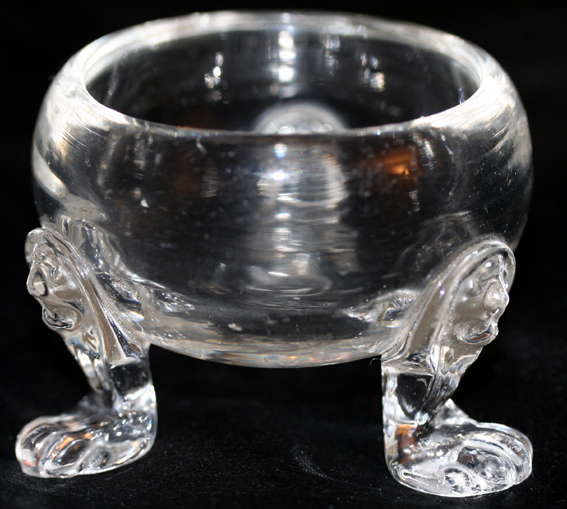
The Salt Cellar: Object Inspiration

By Photo by Nick Michael (Private collection)
[Public domain], via Wikimedia Commons
On every visit, the salt cellar takes me back to our first meeting.   

When we flew from Washington, D.C. to London to meet my boyfriend’s parents, I was nervous and intimidated.  Their flat was in the upscale Mayfair area of central London.  Their neighbor was ‘Punch’ Sulzberger, former publisher of the NY Times.  They belonged to dining clubs.  

Their apartment overflowed with status, each museum-like piece reminding me of my modest experience in life. Persian rugs.  Original oil paintings.  When we sat down for dinner, there was so much sparkling crystal and silver, I felt the need to shade my eyes.

The intricately carved silver salt cellar (no, no, not just a bowl – a cellar) sat on the table mocking me.  The salt rested there, open-faced, fresh, clean white grains.  I LOVE salt.  I needed salt.  But…there was no spoon. 

Read more!

Sunday, November 17, 2013

Favorite Writing Tips

Nathan Bransford's contest to win a Kindle in honor of his new book How to Write a Novel is over, but he's published many of the "Favorite Writing Tips" he received as contest entries.

I quoted Lela, the winner, in my comment to J.A's post last Wednesday: "Write. Write poorly, but WRITE."

But there are other gems . . .

Read more!

Wednesday, September 25, 2013

Modifying a Longstanding Tradition


Something really stuck in my mind about the novel I recently read (Tabloid City by Pete Hamill) - not the plot or the writing, but the… punctuation. 

Instead of quotes to indicate dialogue, the book uses a beginning dash.  See a few sentences here in which the tabloid’s editors, Briscoe and Logan, are talking about a murder being investigated by a young reporter called Fonseca:

Read more!

Saturday, September 14, 2013

Creating Memorable Characters

What makes us remember a character? Not what they're wearing, or the color of their hair, but "their quirks, their body language, their histories, their beliefs." How does a writer create vivid, memorable characters?
Read more!

Saturday, August 24, 2013

WWED?


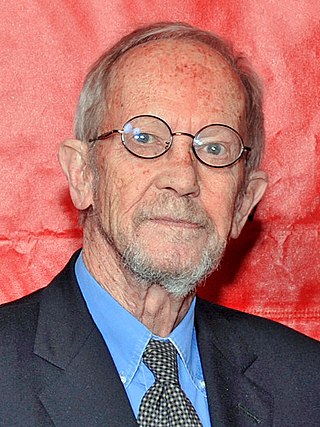
Farewell, Elmore Leonard, father of five children and 45 novels.  Glimpses of your hugely successful writing process will continue to inspire those of us struggling to find a fraction of your writer's life.

  • Elmore Leonard talked about his approach to Bob Greene (Wall Street Journal): "When I get into the writing, I have a pretty good idea of who the main characters will be. But I still don't know exactly how the story will work. And something happens to me in almost every book: A character that, in my mind, may have been fairly minor turns into a major character. I hear him talking, and I realize: This guy is interesting."
  • Elmore Leonard always wrote a scene from a single character’s point of view, then often rewrote the same scene from another character’s POV to see if it was more effective.  
  • His use of dialogue is legendary.
  • Though he started writing in the 1950’s, he ‘found his style’ after reading George V. Higgins’ classic 1970 crime novel The Friends of Eddie Coyle, with its prolific profane dialogue: “I read it and I changed my style somewhat…I started to use expletives where they belonged. I started to open my scenes with dialogue. Higgins set me free.”

Read more!

Saturday, August 17, 2013

The Inner Truth of Teenagers


Why do teens love dystopia?  Well, according to Patrick Ness, best known for his extraordinary Chaos Walking trilogy, “Arbitrary authoritarian rulers. Nothing makes sense and there is no escape.  The grim social order is relieved by flashes of personal connection here and there...

Read more!

Sunday, August 4, 2013

"Everything You Feel Like Telling"

I am reading Edith Wharton's autobiography, A Backward Glance. It is rich with information on her development as a writer. Most interesting is her commentary on her critic, Walter Berry, who essentially "taught" her to write. I quote much of what she says in its entirety, as it is invaluable for both writers and critics.

About Walter Berry, she writes: "No critic was ever severer, but none had more respect for the artist's liberty. He taught me never to be satisfied with my own work, but never to let my inward conviction as to the rightness of anything I had done be affected by outside opinion."

Stuck with the development of a novel, she asked his opinion.  "He looked through what I had written, handed it back, and said simply: 'Don't worry about how you're to go on. Just write down everything you feel like telling.' The advice freed me once for all from the incubus of an artificially pre-designed plan, and sent me rushing ahead with my tale, letting each incident create the next, and keeping in sight only the novelist's essential sign-post; the inner significance of the "case" selected. Yet when the novel was done, I remember how meticulously he studied it from the point of view of language, marking down faulty syntax and false metaphors, smiling away over-emphasis and unnecessary repetitions, helping me patiently through the beginner's verbal perplexities, yet never laying hands on what he considered sacred: the soul of the novel, which is (or should be) the writer's own soul."

It is good to know that even one of America's greatest writers struggled to learn, and that the manuscripts she produced (according to a guide at The Mount, she wrote every morning in bed for four hours) all needed help from a sharp-eyed critic who respected what she was trying to say.


Read more!

Wednesday, July 24, 2013

A Writer's Workout


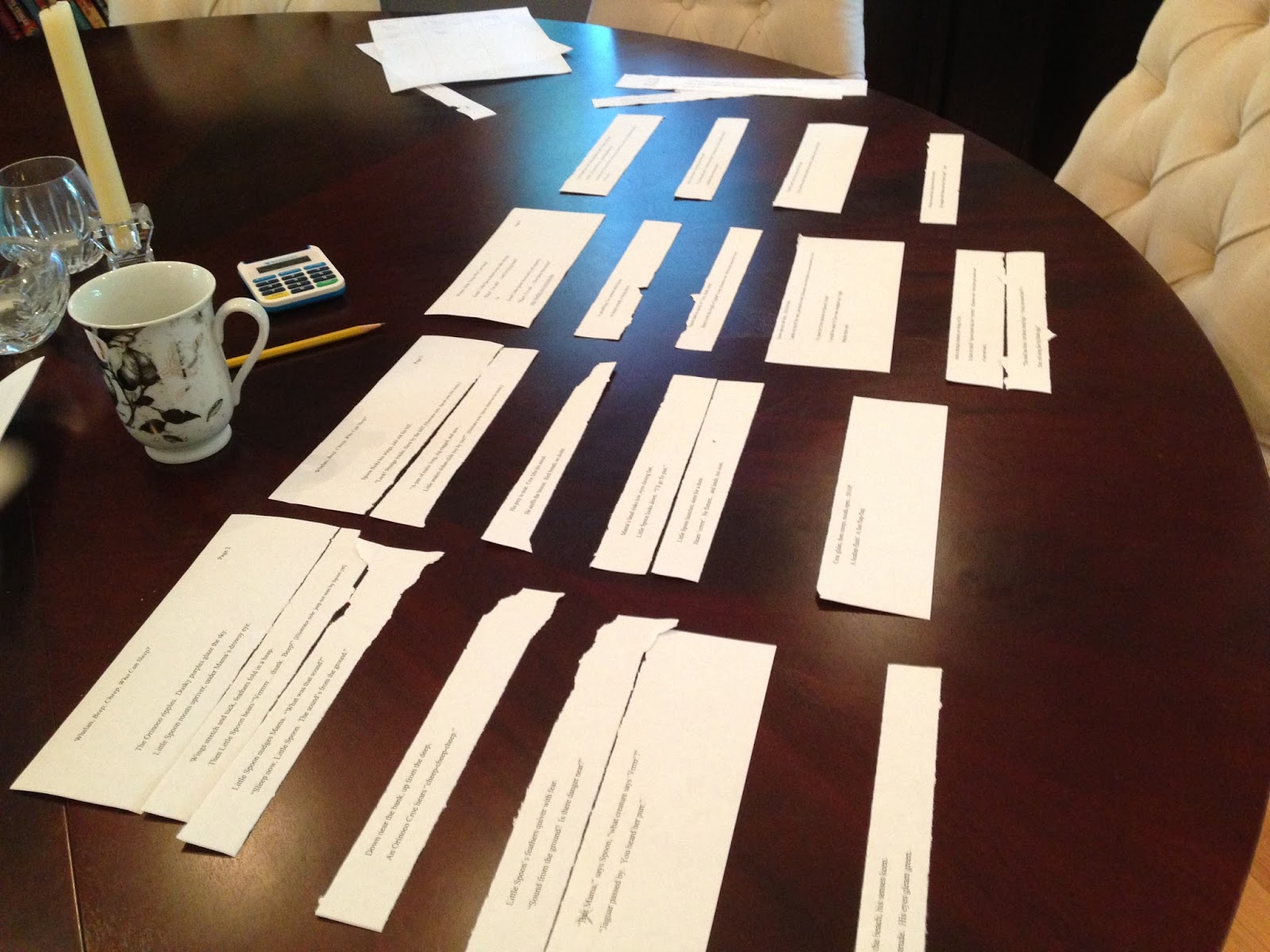
At the suggestion of a critique partner, I cut my latest manuscript into pieces.  I tell ya, critiques can be rough!

Seriously, they can.  But this was a new angle on revision.  I’m putting my ms back together like one of those magnetic poetry puzzles.  I mix and match the couplets that make up my PB, see what’s essential and what’s not.  In one exercise, I looked at only scenes with the main character.  A verse I thought was critical is actually redundant.  In another, I looked at only the bad guy.  Turns out he might be just as threatening without a verse or two.  Next, I’m going to rearrange the scenes with plot flow in mind. 

Something about the physicality– the touch and the visual of the paper pieces moving around, pushes my creativity button.  It’s also faster than doing it online. 

More physicality to come when I create a PB dummy for dummies by taping the paper verse over the text in an existing picture book.  You can see page turns and imagine the rising and falling action.  (Another helpful suggestion from a critique partner!)  All this physical hand waving and paper movement – maybe I'll lose some weight.

It’s impressive what new insights can be gained by viewing a puzzle from a different angle, like unexpectedly viewing a mirror or photograph of myself from the back (ooooh, that writer’s workout isn’t reaching much beyond my elbows...). 

Another great suggestion for a paper and glue workout comes from an interview with Jo Knowles (Lessons from a Dead Girl) on Inkygirl.  For her novels, she creates a storyboard.  Each chapter is represented by a simple picture (think stick figures a la Blues Clues), a quick plot summary below the picture, and the strongest emotion labeled at the top. The story arc is immediately apparent -- a one glance view of the ms.  It’s a great tool that should be just as (if not more) useful for PBs as well.

So writers, go get physical!  Let me know if you have any other suggestions for a writer’s workout, especially any that work off the weight that shows in those rear-view pictures.

Read more!

Monday, June 17, 2013

Why Famous Writers Should Complain About Writing


Anne Lamott says ”Almost all good writing begins with terrible first efforts. You need to start somewhere.”  Writers, if you don’t feel that way—if you happen to find writing effortless and easy—do the rest of us a favor and lie.

J.K. Rowling apparently wrote the complete story arc for the Harry Potter series on a long train ride, and then wrote most of Sorcerer’s Stone in cafes while her new baby was napping. Napping??? People, I was barely groomed the first year of my child’s life, let alone able to churn out a groundbreaking, genre-busting bestseller. It’s true that Rowling was on welfare at the time, her manuscript was rejected repeatedly before going on to revolutionize the industry, and from what I’ve read, all that success couldn’t have happened to a nicer person. But still. Jo, couldn’t you have worked up some writing block story to make the rest of us feel a little better?

By way of contrast, I give you Michael Chabon's story of writing The Yiddish Policemen’s Union.

Read more!

Wednesday, April 10, 2013

Weaving a Sense of Place

Sharon Wildey Calle

After a week's vacation in the "Land of Enchantment" (New Mexico), I have come home inspired and ready to write.

My only challenge... How do I recreate the diverse and magical spirit of this environment as a setting for a story?

Read more!

Sunday, March 10, 2013

Recipe for Writing Success


We all have our tried-and-true recipes that we return to time after time for potlucks, dinner parties, or family meals. But what is your recipe for writing success?

Read more!

Saturday, February 16, 2013

Mo Willems - "Why Books?"


Mo Willems and his pigeon. Smile material. Masterful picture books!
In 2011, Mo was invited to give the prestigious Zena Sutherland Lecture. He titled his talk "Why Books?"
Here are some highlights:

Read more!

Tuesday, February 12, 2013

Staring at a blank page (or screen)


As I was brainstorming for my blog post, I was determined to write a post that was relevant, interesting, inspiring, and witty. I had no trouble deciding between multiple ideas. Because I had absolutely no ideas to choose from.

Read more!

Monday, February 4, 2013

Adverbially Speaking

In the last year or so, two adverbs have crept into common English usage: "famously" and "arguably." One cannot read a column or news article without seeing them. "As Shakespeare famously said..." or, "Julia Child, arguably one of the world's best..." Any day now I expect to see "George Washington, arguably the first American President..." Both words add nothing to any sentence in which they are used.

Read more!

Friday, February 1, 2013

Wrongs and Writes


Like many writers, I suffer from a dreaded writerly disease: trying to write it right the first time. I agonize over sentence structure, search my thesaurus for the perfect synonym, and doubt every plot line.

So when I came across this New York Times Magazine Article that reminded me how important it is to be wrong -- and "to be wrong as fast as you can," I considered once again how overrated right is. In the article, Hugo Lindgren reviews a list of ideas he's had throughout the years and wonders why he hasn't written them. He recounts a Charlie Rose interview with Pixar's John Lasseter:  

Pixar’s in-house theory is: Be wrong as fast as you can. Mistakes are an inevitable part of the creative process, so get right down to it and start making them. Even great ideas are wrecked on the road to fruition and then have to be painstakingly reconstructed. “Every Pixar film was the worst motion picture ever made at one time or another,” Lasseter said. “People don’t believe that, but it’s true. But we don’t give up on the films."

Read more!

Wednesday, January 23, 2013

Drive Past the Predictable


Here's some good advice:  keep your plot unpredictable.  While that's easy to say, it's not so easy to do. 

I picked up a great tip on this challenge recently:  use your critique partners, not just for review, but for breaking through those tough plot bottlenecks.  

Try this exercise:  set the stage (your MC had a huge fight with her best friend), and ask your critique partners what might happen. 

Wait for the first answer (she storms off and refuses to talk?) and avoid this at all costs: the predictable plot. 

Read more!

Sunday, January 13, 2013

“Second star to the right and straight on 'til morning. ” ― J.M. Barrie, Peter Pan


Peter Pan Illustration by Kathleen Atkins


How do you enter the magical world of your young readers?

To get into the right mindset, I think back to how I felt as a child. I also get lots of ideas from my students (I teach elementary art).

But how do you tap into that world if you don’t interact with children on a daily basis?

Read more!

Friday, December 21, 2012

My News!! And a Giveaway!!

Okay, so, I wasn't going to post this quite yet since I'm sure everyone is busy with the holidays but  I can’t hold it in any longer…


I HAVE A BOOK DEAL!!!!!!   Balzer + Bray is publishing my debut YA, The Promise of Amazing, in 2014!!!  Champagne for everyone!!!

I’m still pinching myself.

In honor of this and in the spirit of Christmas, I’m having a GIVEAWAY!!!   

In the comments section, tell me which writers have influenced you and why and I’ll randomly select someone to win a $25.00 Amazon gift card!  Okay, my turn:

One of the writers who has influenced me is fellow Jerseyan, Judy Blume.  Are You There God? It’s Me, Margaret was the first book I remember falling in love with. I lived in that book. It was also the first book I read over and over again.  What struck me most about that book was the way it made me feel.  I was going through some of the same things that Margaret was going through…trying to figure out where I fit in, who my friends were, getting a bra, (worrying about having something to fill out said bra!), and going to my first boy/girl parties.  These were thrilling, yet sometimes, scary events!  Reading about someone going through those same things made me feel that all the emotions, the highs and lows, that I was experiencing were…normal.

This is what I aspire to do in my own work -  to create characters and stories which grab you by the collar and pull you into their world.  To laugh, cry and maybe even recognize yourself there.

So how about you, Paper Waiters?   Which writer has influenced you?  Any comments left before midnight on December 24th will be eligible for the giveaway!!  (Just make sure to include an e-mail address so I can contact you!)

Oh, and I apologize for the overuse of exclamation points...but I just can't HELP IT!!!!!!


Read more!

Wednesday, December 12, 2012

Resolving to Write


With the New Year just around the corner, resolutions for 2013 come to mind.

I resolve to write one picture book manuscript each month. How will I keep that resolution, you may ask?

Read more!