Writer or Author, which comes first?
Is it the cow before the horse?
Author, writer, writer, author,
both create, of course!
Are we writers because we sit and write, or are we authors because we slave across the page? I always wondered which is accurate. How often do people ask you, "What do you do?" "I'm a writer" you respond. "So, are you an author?" they say.
Does a person who writes need to be published before she/he becomes an author or are we authors and when we become published do we ascend to writer status?
Webster is unclear but indicates that the terms are synonymous.
Author - "One that originates or creates; the writer of a literary work."
Writer - "Author; one who writes."
So....Webster doesn't mentioned being published as a requirement to be either an author or writer. "He" does mention "literary" works. So, works not literary ...are written by............
Webster also mentions:
Writer's bloc - the psychological inhibition preventing an author from proceeding with a piece
Writer's cramp - a painful spasmodic contraction of muscles of hand or fingers brought on by excessive writing
So, whether writer or author, let's try to avoid,
the stumbling blocs and the cramps so tight,
and apply fingers to keyboards,
and create as we write.
Writer....Or ....Author?
Saturday, March 28, 2009
Definitions


Wednesday, March 25, 2009
Time on My Hands

In September, my youngest child went off to college. It was quite an adjustment for me, more than I ever expected. Suddenly I had time on my hands. Most people would find this to be a blessing. That was not my experience. I found myself wondering how I was going to fill the day. Acquaintances offered their opinions on what I should be doing with my new found time. One suggested volunteering. A very valuable consideration, but there are two non-profit organizations with which I have been involved for more than ten years, so I did not feel the need to find another organization just to volunteer. Another suggested returning to the work force. But I haven't worked in close to 20 years and therefore, am no longer qualified for anything more than being a greeter at Wal-Mart, which holds no appeal. A good friend, who had recently entered the land of empty-nest herself, told me to take my time figuring out what I wanted to do. "Don't rush into anything," she said. "Find something you're passionate about." So I took her advice...
I want to write books for children and young adults. Duh! Didn't I already know that? Yes, and no. Finding myself with time on my hands made me wonder if this was what I was supposed to be doing, or if I should be out in the world doing something REALLY important like cleaning up cat and dog poop at the local animal shelter or directing lost shoppers to special price deals in aisle 7? When I spent day after day starting at a blank Word document I had to ask myself, how can I be a writer if I'm not writing? I came to the point of put up or shut up.
I decided to put up. I decided re-commit myself to my writing. I attended an NJ-SCBWI Workshop which I hoped would light a fire under me and I began searching for ways to improve my writing. The workshop was a success in that it definitely lit a fire. The editor I was paired with was interested in seeing one of my stories after revisions and the critique and first page session gave me new ideas for revising a second story (see my post "A Fine Line" on 2/25). To improve my writing, I decided to apply to the Vermont College of Fine Arts MFA program in Writing for Children and Young Adults. Suddenly, I didn't have so much time on my hands. I had to write two essays for the application and I had two YA manuscripts to revise before sending to editors. Additionally, I had my regular homework to do in the class I am auditing on Medieval Christianity at Drew University (a great experience but the topic for another post).
THEN, with another case of when it rains it pours, an agent kindly rejected my historical YA but expressed interest in my contemporary YA.
In all of this, I discovered something about myself. I work better under pressure. Perhaps not extreme pressure, but certainly with deadlines -- lots of deadlines. Otherwise, I procrastinate to the point of being completely unproductive.
So, in keeping with what I am learning in my Medieval Christianity class, I am undergoing a personal reformation. I am remaking myself - trying to return to my old productive self who wrote everyday, while striving to reinvent myself into the writer I want to be.
Now, having said all this, when you read this I will be sunning myself on board Celebrity's 5-day Caribbean cruise so I might not be able to respond to comments as frequently as I might like. But don't worry, I'm taking a stack of YA's to read and I will be revising my contemporary manuscript, all while drinking fruity umbrella drinks.
Sunday, March 22, 2009
Courage to Fail
Tomie dePaola saw his share of rejections when he began writing and illustrating for children. But few writers match the success he sees today. So what is his one word of advice for aspiring authors? Courage. More specifically, having the courage to fail.
I need a shot of courage whenever I write a picture book. I'm much more in my comfort zone as a novelist. Anybody else need a shot of courage these days?
Wednesday, March 18, 2009
Lose and Learn
Last fall I entered the Children's Writer contest for a 125-word seasonal piece for a pre-k audience. Now I've had good fortune with their pre-k contests before - once a first prize and once a third prize. This time? Nada. Zippo. Why?
I submitted a non-fiction winter piece about the snowshoe hare. I did my research and included a bibliography gathered from four excellent sources. My 125-word entry described how, in the fall, the snowshoe hare changes color from brown to white and tied that fact to the leaves changing color. Good work, I thought, a reference to something pre-k kids know about.
Then I went on to show how the white coat against snow is camouflage by introducing an encounter with a hungry fox to demonstrate how the hare can avoid disaster. The final two sentences dealt with the hare hopping home, showing how its special paws work to keep the hare from sinking into the deep snow.
Okay, so where did I go wrong? When I saw the three winners, I knew immediately. They had more child appeal. And all three winners rhymed! Editors are always discouraging rhyme, but when well-crafted, it's perfect for the pre-k crowd. My first and third place winners in previous pre-k Children's Writer contests? They rhymed. Good rhyme = rhythm = child appeal.
Does this mean I should always write in rhyme? No, but it does mean I should never forget my strong suit and even if it doesn't rhyme, I should give my prose the rhythmic lilt of poetry. I had concentrated on cramming information into 125 words. My sentence structure was wooden and choppy. I needed to make those blasted words sing! And I didn't.
Sunday, March 15, 2009
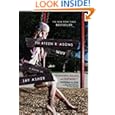
Thirteen Reasons Why
Here are 13 reasons why Jay Asher is my hero:
1. Before Thirteen Reasons Why, his best-selling YA book about a girl who commits suicide, his first 11 manuscripts were rejected by publishers, but he never stopped writing.
2. He understands “edgy.” (See Robin’s March 4th post.)
3. He quit college to pursue a writing career and actually succeeded.
4. Before he sold 13RW, he had a great team blog called Disco Mermaids (DM), which was an inspiration for The Paper Wait. He posted a lot about rejections but ultimately about “the joy and tears of selling a first book.”
5. A few years before he sold 13RW, he started a thread on the Verla Kay blue boards called “Ready to Quit!” He didn’t, which is how he got where he is now.
6. Even though he crossed to the other side, he hasn’t forgotten pre-published writers like myself, including gifting a scholarship to SCBWI.
7. It took him 12 years to sell his first book. Knowing this, I’m giving myself permission to take 15 (12 + 3 for the bad economy), if necessary.
8. Not one but three editors wanted to buy 13RW, so the book went to auction, with the stipulation that he could speak with each editor by phone to choose the one who was right for him. He said this made him feel like Goldilocks, looking for the editor who was “just right.”
9. 13RW was the first non-humorous YA book he ever wrote. The 12 years before that he spent trying to sell humorous books for younger readers, so switching genres paid off.
10. He’s a 30-something guy who mastered a teen girl’s p.o.v.
11. His book is No. 3 on today’s NY Times chapter-book best-seller list. He was also featured in a NY Times article last week.
12. In a DM audio interview, he said that after three and a half years of writing the manuscript, he finally had his critique group read it. Their critiques were so harsh, he felt he needed a more positive critique that would make him feel comfortable sending it out to editors...
13. ...So he sent the manuscript to his Mom. (I have two sons, so the fact that he looked to her for inspiration really ups his hero status.) When Mom said, “This is beautiful honey, a real piece of art,” out it went. You know the rest. (Hmm. What does this say about critique groups?)
Thursday, March 12, 2009
Good News, Bad News
Much is written in the children's literature blogosphere about how to handle rejection, how to slough off bad news and go on, how to tackle all the negativity that writers get heaped on them year after year. But not much is written about how one handles good news, for obvious reason. Good news, generally, is like Haley's comet - it is ridiculously infrequent and if you blink, you might miss the blaze across the sky.
I actually got good news recently. I signed with an agent, she loves my manuscript, she gave me a few reasonable notes for changes, and she subsequently loved the changes I made. She plans to go out with the book this week. This is all good news, no doubt about it. Of course, I'm happy. But I'm also full of suspicion and disbelief. I've spent lots of time recently crafting the most catastrophic ending to this happy tale. It's kind of embarrassing, to be honest. Why can't I simply enjoy my good fortune? That's where all the bad news comes in. I'm trained to assume the worst at this point, and it's a hard habit to shake. Anybody else out there do the same thing?
Sunday, March 8, 2009
Reading Like a Writer
When I taught elementary school, one of my students' favorite subjects was always "Writers' Workshop". (No surprise considering my own passion for writing. :o)) And, as part of Writers' Workshop, I used to give my students mini-lessons on how to "read like a writer". In these mini lessons, I would share with my students carefully collected story openings or story closings or snippets of dialogue. In these lessons, I tried to make my students aware of how these wonderful authors whose craft I was sharing with them could be their actual writing teachers. They (and I) could learn so many wonderful techniques from such careful reading of children's literature.
I continue to learn a great deal from other writers. But, now that I'm a much more serious children's writer, reading like a writer has come to have an expanded meaning for me.
Yes. I now experience another emotion when I read a perfect book.
Envy.
Okay, envy doesn't adequately describe it. (We writers must always search for the perfect word, mustn't we?) It's more like a combination of exquisite appreciation for the perfection of what the author has accomplished... combined with absolute despair of ever being able to accomplish anything anywhere close to that good in my own writing!
Books that have given me this wonderful/awful feeling include Thirteen Reasons Why by Jay Asher, Rules by Cynthia Lord, Flipped by Wendelin Van Draanen, Because of Winn-Dixie by Kate DiCamillo, The Giver by Lois Lowry, Dragon Slayers Academy by Kate McMullan and Art by Patrick McDonnell. These are books that have hooked me so totally and completely that I can't "read like a writer". Not on the first reading (or two) anyway. I am just completely swept up in a perfectly told story. And when I go back to see why the story was so perfect... I usually end up swept up totally and completely once again. These stories are that good!
And then I wish that I could create something like the book I just read. Something serious or thought provoking or hysterically funny (depending on what the last book I read was). Oh how I wish that I could!
But I can't. Because I write my own stories with their own unique voice and they're different from all my favorite authors. (Oh how I wish I could write thought provoking adventures like Margaret Peterson Haddix!)
Yet I know the reading of these wonderful books must expand me as a writer. They encourage me to expand my horizons and to shoot for perfection in my own writing. To try to create a book someday that will give some other writer that wonderful mingling of joy and despair. To create a book that will leave that type of lasting impression on my own future young readers.
So, I'm curious, how has being a writer changed your reading? And are there any "perfect" books that give you the feeling I've described?
Wednesday, March 4, 2009
Defining Edgy
If you've been to a writer's conference in the last ten years, odds are you've heard the word "edgy" used to describe the type of manuscripts editors are seeking. I've also heard "fresh voice" and "characters that leap off the page" but those qualities I can understand. It's that edgy word that leaves me feeling just a bit, for lack of a better word, edgy.
Pressed further, some editors can't really define the quality. They just know it when they read it. And I guess I can understand that too, but as a writer it's frustrating to want to emulate that indefinable something that will make your manuscript stand out. So, in my quest to understand edginess better, I looked the darn word up.
There are three definitions of edgy at Merriam-Webster.com, for my purpose, #3 hits the mark.
Edgy: Having a bold, provocative or unconventional quality.
That's a definition I can wrap my mind around. yet it brings more questions. What exactly makes a book edgy? Voice? Plot? In your face realism? I Googled "Edgy YA Fiction" and was lead to the website of the CBCC. (Cooperative Children's Book Center, University of Wisconsin-Madison) I picked two books from their edgy YA list that I was familiar with to do an "edgy" breakdown and comparison.
The Outsiders by S.E. Hinton. I suppose this would be considered "old school" edgy. I read this book in freshman lit and was instantly pulled in because it spoke to me. Not with flowery language, or obscure symbolism, but to ME, a teenager. The boys in The Outsiders were not well behaved. They drank, they smoked and they got into lots of fights. And while there were no "Greasers" or "Socs" in my school years, I could easily identify with the introspective Ponyboy and his plight of wanting to be accepted in society.
Speak by Laurie Halse Anderson. I was a bit out of my teen years when I read this book, but from page one felt transported back to high school and all its dramas. Again, the story spoke to ME or my inner teen, with the need of wanting to fit in. Melinda Sordino did not sugarcoat the reality she was living through. It was harsh but often humorous and ultimately real. Speak was also a book that was most often cited at conferences I've attended as an example of "edgy".
What both books have in common is a first person, no holds barred, "here's my naked reality" quality to them. Both also contain bleak subject matter and dark crisis points. And both don't have "big red bow" endings but do leave the reader with the hope and understanding that the protagonist does indeed triumph. They each easily fit the definition as having a "bold, provocative or unconventional" quality. But does this help me in my quest to understand edginess? Maybe a little.
I don't think there can be an ultimate "edgy" checklist, nor do I think edginess is a quality a writer can strive to attain. Not all edgy books will be told in first person (Unwind by Neal Shusterman...so edgy I cut my fingers while turning the pages). On the other hand, many, if not all, edgy books I've read have at their heart some very grim subject matter. But does a book need to contain dark subject matter to be edgy? I guess, what is comes down to, is that you know "edginess" when you read it.
So how would you define edgy?
Saturday, February 28, 2009
Revisions - Again!
I spent the last week revising two WIPs that I have had at our critique group in the past year. As Meg has been saying, we have a great group. The members isolate the elements of the manuscript that need work, and once the writer digests the reviews, she can see that they are right on - that this character needs more or different motivation or more realistic dialogue, or that you might need a different angle on the plot.
I often wait a bit after the group critique and then can go back and read and assimilate the comments in the context of time and the whole story. Most of us couldn't do without an involved critique group. Our group knows each other's story characters almost as well as our own and looks forward to seeing them again in successive chapters and critiques.
I was revising my picture book about beaches and a story about New York Island and harbor over the last few weeks, and as I was going over the manuscripts, I could hear again the various members of the critique group suggesting their solutions for specific problems in the stories. As you struggle to make the right fixes you hear their voices and explanations, and as you work by yourself, you feel you are discussing the pros and cons of each choice with mentors, and coming up with good solutions.
Revising is sometimes fun, and always work, but with the suggestions of a good critique group to consider, it produces a good story.
Wednesday, February 25, 2009
A Fine Line
Last Sunday I attended a NJ-SCBWI Mentoring Workshop at which there was a First Page Session. In preparation for this I submitted a first page to my critique group. It was a revised first page of a WIP that has been IP for years. It's a project that, for one reason or another, has been difficult for me. I've stopped and started, abandoned and returned to it many times. In the current return I have decided to pretty much chuck all that I'd written previously and take on a new direction with a new main character, new POV, and essentially new everything.
My critique group trashed it.
Yes, this group of writers who I consider among my best friends literally ripped my first page apart. A first page! Quite honestly, I didn't know one could find so much wrong with a single page. Don't worry, they all did it in a nice way and started and ended their eviscerations with positive comments, but Gale still had to call me the next morning to make sure I wasn't planning on doing a Sylvia Plath. (I wasn't, just so you know).
I went off to the Workshop on Sunday with two first pages. The first from my contemporary YA which has been critiqued in so many First Page Sessions I felt confident it would not be torn to shreds in public - it was safe. The second first page in my writer's bag was the ripped-to-shreds first page of my current WIP with a few minor changes (the ones that could be managed without a complete rewrite). Standing at the desk where I was instructed to leave my first page, I couldn't decide which one to leave. My hand was on the ripped-to-shreds one, but my ego wouldn't let me pull it out. I chickened out and put the safe first page on the pile. My skin was not thick enough to weather a second shredding in less than 48 hours.
Something you should know about me is that I love First Page Sessions, often finding them the most valuable part of a conference. It doesn't matter if the first pages are accomplished pieces of writing simply waiting to find the right editor or a newbie written page that makes you cringe just to listen to it (and admit it, there's always at least one in a first page session that makes your hair stand on end). I learn something from every page that's read.
What I learned on Sunday when the editors read my safe first page was that I had some dialogue that wouldn't really happen, but conveniently allowed me to bring up a point of tension between two characters. That's a valuable criticism and something easily fixed.
But what I REALLY learned on Sunday came from other people's first pages -- To recognize the thin line that exists between starting with action, which is something we always hear, to dropping the reader into a scene without them having the slightest notion of what is going on. A Thin Line. And I understood immediately what my critique group was trying to tell me.
Now one could argue that my beloved critique group could have lightened up a little bit. On the other hand, our group has never been known to blow hot air up anyone's skirt. We all call it as we see it, which is one of the things I value most about the group.
It's another thin line, one we balance on at every meeting.
I'm not sure if I regret playing it safe on Sunday. Given that the rest of the Workshop went so well, maybe I could have weathered a second evisceration if I'd been brave enough to submit my WIP first page. It's a thin line.


